
Leisure, pools & attractions
Safe is what gets checked again every morning.
Between the first safety check in the morning and opening to guests lies the real work: measuring the water readings in every pool, checking slides and rides work, checking rescue equipment and first aid supplies, cleaning changing rooms and showers, adjusting along the way when a reading is off or an attraction needs maintenance at short notice, and in the evening securing the site and preparing it for the next day. Every shift hands this state over to the next. Set down as a clear process, the slide opens just as safely on Monday as on Saturday, no matter who is on duty today.
The same standards, from the local outdoor pool to the theme park with thousands of guests a day.
Every device has its own tasks
Filter system, pool plant, slide, ride and sauna are not a single "check the site" item on a list. Every device has its own tasks, split by opening and closing: backwash the filter system, check the pool water for chlorine and pH, check the slide for cracks and secure fixings, start up the ride according to the manufacturer's instructions.
Businesses name their devices by type rather than by a generic name. When the park has several roller coasters or the pool several basins, "Pool 2 non-swimmers" makes it immediately clear which one is meant, and the inspection instructions match the exact device rather than a category.
Every task can be linked to devices from the catalogue. From the moment it is linked, the system automatically provides the matching operating manual: it is attached to the device and its text is searchable. The AI assistant answers questions from it, without anyone having to hunt for the manual.
Multilingual is the norm here
Tasks are created and evaluated in the business language, German or English. Every staff member sees them in their own language: German, English, Spanish, Serbian, Russian, Turkish, French or Vietnamese. Pool attendants, lifeguards, maintenance and sales staff in this industry rarely come from a single country — that is not a special case but everyday life.
The language follows the person, not the location. Anyone who prefers to read in their own language gets the tasks that way, while setup and reporting stay in the business language for management.
The business starts at the entrance, not at the counter
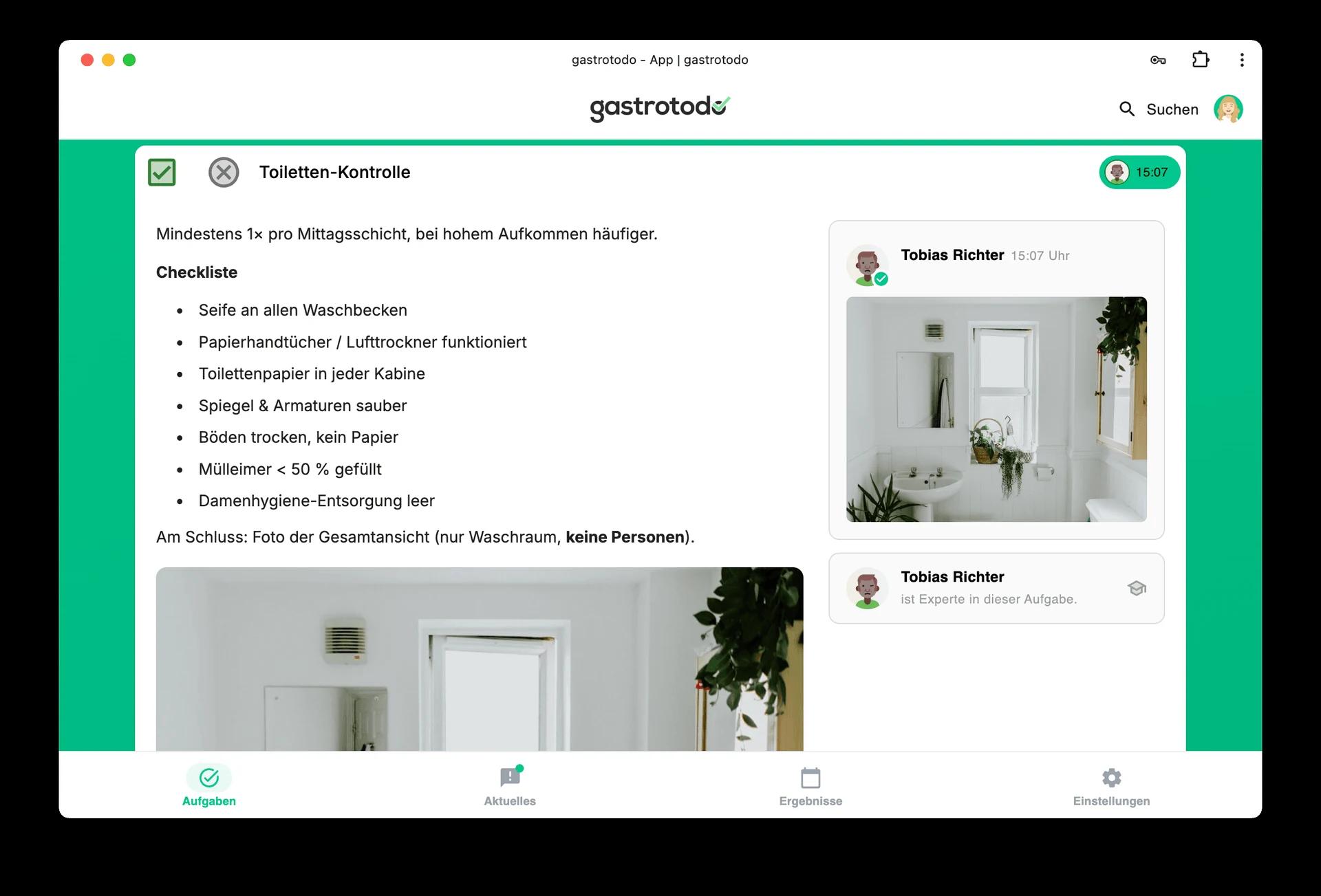
Open and clean the changing rooms, unlock the toilets, do the litter round along the beach, check the sanitary building, set up parasols and outdoor furniture: all part of the business but outside the dining area — and nobody walks past it by chance.
Then there is the season. Areas appear for a while and disappear again, and for a beach business an annual figure means little. What matters is how quickly the site is fully running again in spring.
Safety is logged like hygiene
Alongside the cleaning tasks run checkpoints on the site: document water readings several times a day, confirm the daily safety check of the rides before opening, check rescue equipment is complete, keep supervision at the pool staffed without gaps. Plus the task of confirming the sign-off of an attraction in writing after every maintenance, before the first guest gets on.
So the record here is not only about the authorities — in an emergency it also protects the business itself. A pool or park documents that every slide and every pool was checked before the first guest arrives.
What theme park and pool operators want to know first
We have several pools and attractions with different inspection intervals. Does that fit in one system?
Yes. Every device gets its own inspection frequency, whether daily, weekly or as the manufacturer specifies.
How often a day can a task like the water reading check recur?
As often as you like. You set up hourly checks as individual tasks per time slot, which later shows exactly which round was missed.
An outside company maintains our rides. Does it still work?
Yes. Task content can be shared for external access via QR codes, and the maintenance company works through its checkpoints right at the device, without needing a login of its own.
We also have a kiosk or a restaurant in the park. Does that run in the same system?
Yes. The catering can run as an area of its own with its own hygiene tasks, right alongside the technical checks of the site.
Ready to structure your business?
Start with gastrotodo — try free for 7 days, then carry on with the plan that fits your business.